Designing a MySQL Database for B2B Energy Products
Design a scalable MySQL database for B2B electrical and renewable energy products with tier pricing, categories, brands, and multi-currency support.
1. Introduction#
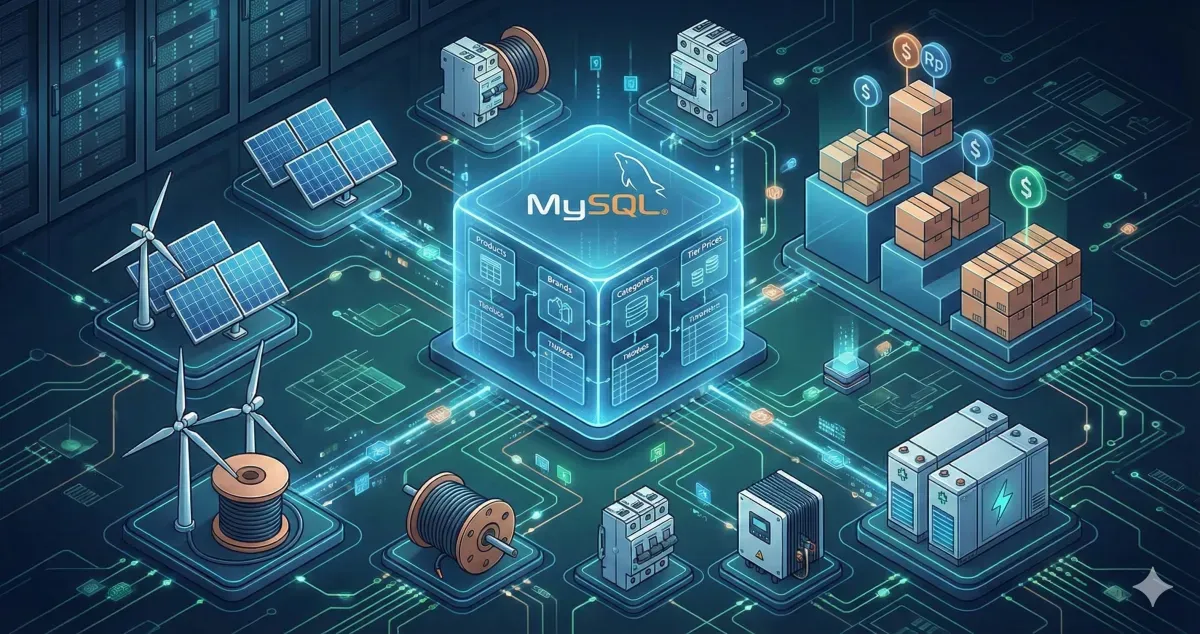
In this article, we will walk through how to design and implement a MySQL database for a B2B project that manages electrical materials and renewable energy products.
The system will handle:
- Core product data (SKU, price, stock, etc.)
- Multi-level categories (category → subcategory → sub-subcategory)
- Brand management
- Tier pricing (volume-based pricing)
- Multi-currency support (USD & IDR/Rupiah)
This design follows relational database best practices: normalization, foreign keys, indexing, and scalability.
2. System Overview#
The project is a B2B product catalog + pricing engine for materials such as:
- Cables
- Circuit breakers
- Solar panels
- Inverters
- Battery systems
- Switchgear
- Renewable energy components
Because this is B2B, it requires:
- Tier pricing (bulk discount)
- Multiple currencies (USD & IDR)
- Clear product hierarchy
- Brand-based filtering
- Stock and MOQ control
3. System Architecture Diagram (ASCII)#
System Flow (User → Database)#
+-------------------+
|   B2B Customer    |
+---------+---------+
          |
          v
+-------------------+
|   Web / API App   |
| (Laravel / Node)  |
+---------+---------+
          |
          v
+-------------------+
|   Business Logic  |
| - Pricing Engine  |
| - Tier Calculation|
| - Currency Logic  |
+---------+---------+
          |
          v
+-------------------+
|      MySQL DB     |
|-------------------|
| products          |
| brands            |
| categories        |
| tier_prices       |
| product_categories|
+-------------------+Product Data Relationship Flow (Database Structure)#
                 +----------------+
                 |    brands      |
                 |----------------|
                 | id (PK)        |
                 | name           |
                 +--------+-------+
                          |
                          |
                          v
+----------------+    +----------------+
|   categories   |    |    products    |
|----------------|    |----------------|
| id (PK)        |    | id (PK)        |
| name           |    | sku            |
| parent_id (FK) |    | product_name   |
+--------+-------+    | brand_id (FK)  |
         |            | price_usd      |
         |            | price_idr      |
         |            +--------+-------+
         |                     |
         |                     v
         |            +----------------+
         |            |  tier_prices   |
         |            |----------------|
         |            | product_id (FK)|
         |            | min_qty        |
         |            | price_usd      |
         |            | price_idr      |
         |            +----------------+
         |
         v
+----------------------+
| product_categories   |
|----------------------|
| product_id (FK)      |
| category_id (FK)     |
+----------------------+Tier Pricing Logic Flow (Business Logic)#
Customer selects quantity (Q)
              |
              v
Fetch all tier_prices
ORDER BY min_qty DESC
              |
              v
Find first tier where:
Q >= min_qty
              |
              v
Apply tier price
              |
              v
Return final price (USD / IDR)Category Hierarchy Logic#
Electrical
   |
   +-- Cable
   |      |
   |      +-- Solar Cable
   |
   +-- Circuit Breaker
   |
   +-- Renewable Energy
          |
          +-- Solar Panel
+-- Inverter4. Database Design#
We will design the following tables:
Main Tables#
productsbrandscategoriesproduct_categoriestier_prices
Optional extension:
currenciesproduct_documents
5. Table Implementation#
Category Structure#
Since we have:
- Category
- Sub Category
- Sub Sub Category
We will use a self-referencing (adjacency list) model.
categories table#
CREATE TABLE categories (
    id INT AUTO_INCREMENT PRIMARY KEY,
    name VARCHAR(100) NOT NULL,
    parent_id INT NULL,
    created_at TIMESTAMP DEFAULT CURRENT_TIMESTAMP,
    FOREIGN KEY (parent_id) REFERENCES categories(id)
);How it works#
| id | name | parent_id |
|---|---|---|
| 1 | Electrical | NULL |
| 2 | Cable | 1 |
| 3 | Solar Cable | 2 |
This allows unlimited depth while keeping schema simple.
Brand Table#
CREATE TABLE brands (
    id INT AUTO_INCREMENT PRIMARY KEY,
    name VARCHAR(100) NOT NULL UNIQUE,
    created_at TIMESTAMP DEFAULT CURRENT_TIMESTAMP
);Products Table#
This is the core of the system.
Required Fields#
- SKU
- Product Name
- Description / Specification
- Datasheet
- Price (USD & IDR)
- Stock
- Unit
- MOQ
- Brand reference
CREATE TABLE products (
    id INT AUTO_INCREMENT PRIMARY KEY,
    sku VARCHAR(50) NOT NULL UNIQUE,
    product_name VARCHAR(255) NOT NULL,
    description TEXT,
    datasheet_url VARCHAR(255),

    price_usd DECIMAL(15,2) NOT NULL,
    price_idr DECIMAL(18,2) NOT NULL,

    stock INT DEFAULT 0,
    unit VARCHAR(50) NOT NULL,
    moq INT DEFAULT 1,

    brand_id INT,
    created_at TIMESTAMP DEFAULT CURRENT_TIMESTAMP,
    updated_at TIMESTAMP DEFAULT CURRENT_TIMESTAMP ON UPDATE CURRENT_TIMESTAMP,

    FOREIGN KEY (brand_id) REFERENCES brands(id)
);Product–Category Relationship#
A product may belong to multiple categories.
CREATE TABLE product_categories (
    product_id INT,
    category_id INT,
    PRIMARY KEY (product_id, category_id),
    FOREIGN KEY (product_id) REFERENCES products(id) ON DELETE CASCADE,
    FOREIGN KEY (category_id) REFERENCES categories(id) ON DELETE CASCADE
);6. Tier Pricing Logic#
This is critical in B2B.
Example:
- 1–9 units: $100
- 10–49 units: $90
- 50+ units: $80
CREATE TABLE tier_prices (
    id INT AUTO_INCREMENT PRIMARY KEY,
    product_id INT NOT NULL,
    min_qty INT NOT NULL,
    price_usd DECIMAL(15,2) NOT NULL,
    price_idr DECIMAL(18,2) NOT NULL,
    created_at TIMESTAMP DEFAULT CURRENT_TIMESTAMP,
    FOREIGN KEY (product_id) REFERENCES products(id) ON DELETE CASCADE
);Example Data#
| product_id | min_qty | price_usd | price_idr |
|---|---|---|---|
| 1 | 1 | 100.00 | 1500000 |
| 1 | 10 | 90.00 | 1350000 |
| 1 | 50 | 80.00 | 1200000 |
7. Query Examples#
INSERT INTO brands (name)
VALUES ('Schneider Electric');

INSERT INTO products (
    sku,
    product_name,
    description,
    datasheet_url,
    price_usd,
    price_idr,
    stock,
    unit,
    moq,
    brand_id
) VALUES (
    'MCB-SCH-16A',
    'Miniature Circuit Breaker 16A',
    '1P 16A MCB for residential and industrial use',
    'https://example.com/datasheet.pdf',
    25.00,
    375000,
    500,
    'pcs',
    10,
    1
);Get Product With Tier Price#
SELECT p.product_name, t.min_qty, t.price_usd
FROM products p
JOIN tier_prices t ON p.id = t.product_id
WHERE p.sku = 'MCB-SCH-16A'
ORDER BY t.min_qty ASC;Get All Solar Category Products#
SELECT p.product_name
FROM products p
JOIN product_categories pc ON p.id = pc.product_id
JOIN categories c ON pc.category_id = c.id
WHERE c.name = 'Solar Cable';Multi-Currency Strategy#
Two approaches:
Approach A: Store Both USD & IDR (Simple)#
✔ Fast
✔ No conversion needed
❌ Must manually update exchange rates
Approach B: Store USD Only + Exchange Rate Table#
CREATE TABLE exchange_rates (
    currency_code VARCHAR(10) PRIMARY KEY,
    rate_to_usd DECIMAL(15,6),
    updated_at TIMESTAMP DEFAULT CURRENT_TIMESTAMP
);Then convert dynamically.
For B2B in Indonesia, storing both USD & IDR is usually practical.
10. Performance Considerations#
Add indexes:
CREATE INDEX idx_sku ON products(sku);
CREATE INDEX idx_category_parent ON categories(parent_id);
CREATE INDEX idx_tier_product ON tier_prices(product_id);For large datasets:
- Use pagination
- Avoid SELECT *
- Consider caching tier pricing
Scaling for Real B2B#
To make it production-ready:
Add:
customerscustomer_groups- Custom pricing per group
- Order management
- Quotation system
- API layer
- Soft delete column
Final Architecture Summary#
This MySQL design provides:
- Structured hierarchical categories
- Brand management
- Multi-currency pricing
- Tier pricing for bulk
- Clean relational design
- Scalable B2B foundation
It is optimized for:
- Electrical material distributors
- Renewable energy suppliers
- Solar project vendors
- Industrial procurement platforms